Public art is often discussed as something exceptional. It is associated with plazas, museums, memorials, sculpture parks, and carefully designated civic zones. In this model, art appears as an interruption in everyday life, something placed into the city to be noticed, interpreted, and admired. Yet some of the most interesting cultural shifts in contemporary urban space are happening elsewhere. Art is increasingly moving into the systems people use without ceremony: libraries, schools, hospitals, transit corridors, and stations. In this context, Perth’s Mandurah Line offers a revealing framework for thinking about transport infrastructure not as neutral background, but as a continuous artistic space.
The importance of this idea lies in how it changes the role of movement through the city. A railway line is usually understood in functional terms. It connects suburbs, manages passenger flow, reduces travel time, and organizes urban expansion. It is a practical system of access and coordination. But when public art becomes embedded across such a system, the line starts to communicate more than utility. It becomes a spatial sequence of visual encounters. The commuter is no longer passing only through infrastructure. They are moving through an environment that carries cultural intention.
That shift matters because transport is one of the most repetitive experiences in urban life. People may visit museums occasionally, but they encounter stations and platforms again and again. These repeated movements shape the emotional texture of the city. They influence how public space feels, whether it appears cold or welcoming, forgettable or distinctive, anonymous or locally grounded. Once art enters this rhythm, it stops functioning as a rare event and begins to shape ordinary perception. The station becomes more than a point of transfer. It becomes part of the city’s visual memory.
What makes a line such as Mandurah especially interesting is the idea of continuity. A single artwork in a station can enrich one location, but a coordinated system of artistic interventions distributed across a transport corridor produces a different effect. Instead of one isolated cultural gesture, the line begins to operate like a chain of related experiences. Different stations may carry different artistic identities, materials, narratives, and references, yet together they suggest that infrastructure itself can hold aesthetic meaning. The journey becomes cumulative. It acquires rhythm, variation, and atmosphere.
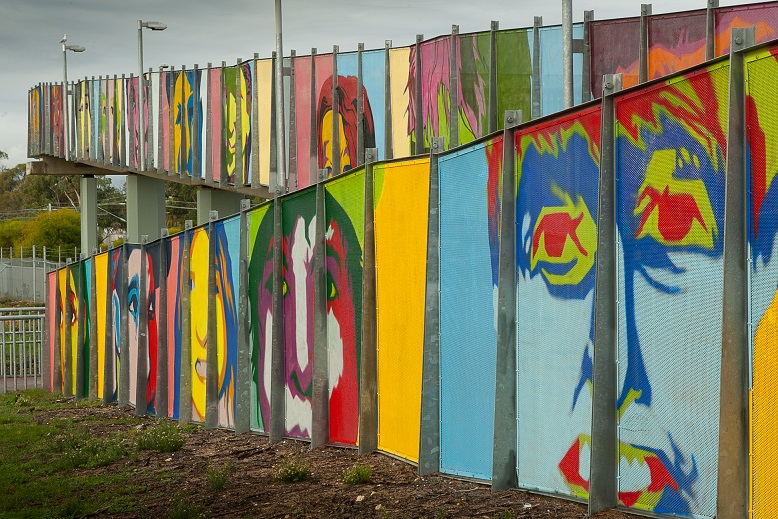
This way of thinking moves beyond the old assumption that public art is merely decorative. Decoration is usually secondary to structure. It is something applied after the essential work is done. But when artistic elements are integrated into the visual language of transport space, they affect how that structure is understood. They influence scale, attention, pace, and orientation. They can bring local stories into otherwise impersonal environments. They can soften the hard surfaces of engineered space. They can introduce symbolism, memory, or cultural specificity into places that might otherwise feel interchangeable.
In a city like Perth, this is especially significant because transport infrastructure often mediates between very different urban conditions. A rail line does not move only through one social or visual landscape. It cuts across multiple communities, densities, and histories. Treating that line as a public art system allows infrastructure to do more than connect geography. It can also register cultural difference. Stations become points where local identity enters a larger metropolitan framework. The line still links places physically, but it also allows those places to speak visually.
This raises an important question about contemporary public space. Who is art for when it is embedded in infrastructure? In gallery contexts, audiences choose to enter. In transit systems, audiences are broader, less predictable, and less self-selecting. That changes the ethics and ambitions of artistic placement. Public art in stations must coexist with speed, distraction, signage, fatigue, and routine. It cannot depend entirely on long contemplation. Instead, it often works through repetition, scale, material presence, and gradual recognition. A commuter may not stop to “study” an artwork, but over weeks and months, the piece becomes familiar. It enters the visual background of life, and from there it can shape mood, attachment, and belonging.
This is one of the strongest arguments for understanding Mandurah Line as a continuous artistic space rather than a set of practical stops. Cultural experience does not always happen through isolated moments of full attention. It often accumulates quietly. A color field glimpsed every morning, a sculptural form passed on the way to work, a patterned surface that catches light differently at different hours, a motif tied to local ecology or community memory-these elements can become part of how a place is known. Public art within transport infrastructure works through duration as much as visibility.
There is also a democratic dimension to this model. When art is distributed across transport infrastructure, it becomes available outside the traditional boundaries of cultural participation. It is encountered by people traveling to work, school, medical appointments, family visits, and daily responsibilities. It does not require a ticketed event, a leisure schedule, or a deliberate act of cultural consumption. This does not automatically make all public art egalitarian in effect, but it does broaden the field of access. It inserts aesthetic and symbolic value into a space that belongs, at least in principle, to everyday collective life.
At the same time, the success of such a system depends on how thoughtfully art is integrated. If public art is added as a superficial afterthought, it risks becoming invisible or purely ornamental. For a transport line to function as a meaningful artistic space, its interventions must respond to architecture, circulation, scale, and local context. The strongest works are not simply placed near infrastructure. They are in conversation with it. They recognize how people move, where they pause, what they notice, and how materials perform under conditions of constant use. In this sense, public art in transit is not only a cultural matter. It is also a spatial and architectural one.
This makes the Mandurah Line conceptually powerful. It suggests that infrastructure does not need to be culturally empty in order to be efficient. The practical and the artistic do not have to be opposing categories. A station can remain legible, safe, and functional while also carrying aesthetic depth. In fact, well-integrated art may improve the experience of functionality itself by reducing visual monotony and making spaces feel more intentional. It can transform the emotional character of transit from pure passage to situated experience.
The broader implication is that cities should stop treating art and infrastructure as separate urban layers. When they are planned independently, culture becomes something occasional and external, while infrastructure remains stripped down to necessity. But everyday life does not happen in isolated layers. People experience cities as total environments. They do not divide their morning into transport, architecture, atmosphere, and culture as separate categories. All of these overlap. The most thoughtful urban systems recognize that overlap and design for it.
Seen in that light, Mandurah Line is more than a transport route. It becomes a model for how movement, space, and public art can form a continuous civic experience. The line connects destinations, but it also connects perception. It invites the possibility that daily transit can hold visual intelligence, local memory, and aesthetic coherence. That is why the idea matters beyond Perth itself. It points toward a larger urban future in which infrastructure is not merely what gets people from one place to another, but one of the ways a city tells them where they are.